

Not every raised floor project has the budget for calcium sulphate or premium steel cementitious panels. Schools, retail spaces, small office fit-outs, and community buildings operate on tighter margins, and the floor specification is often the first place costs get squeezed. The conventional wisdom is that lower cost means lower performance. The HUIYA GRC panel exists to challenge that assumption.
GRC — glass-reinforced cement fiber with a welded steel mesh core — occupies a specific and deliberate position in the raised floor market. It is not trying to outperform premium panels on load capacity or fire ratings. It is delivering 90 percent of the performance that 80 percent of projects actually need, at a price that makes raised floor technology accessible to buildings that would otherwise default to slab-on-grade construction. That is a trade-off worth examining closely.
The Engineering Behind the Price
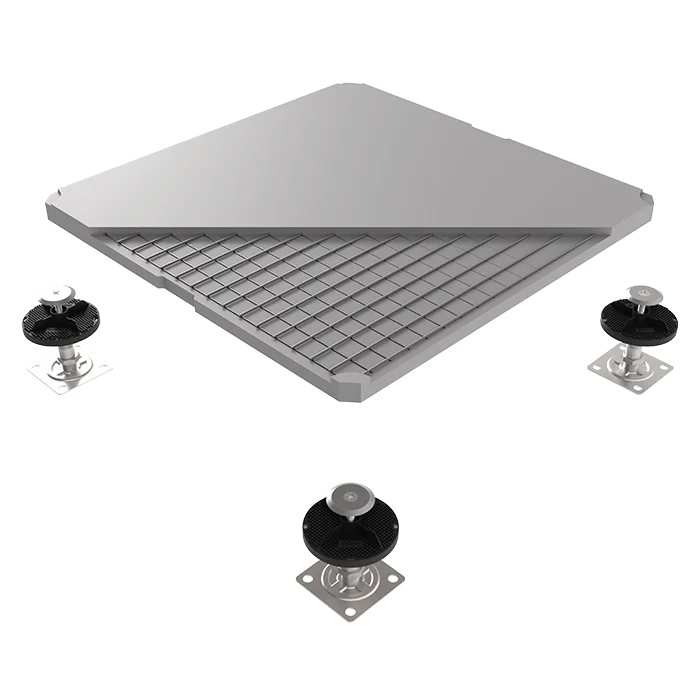
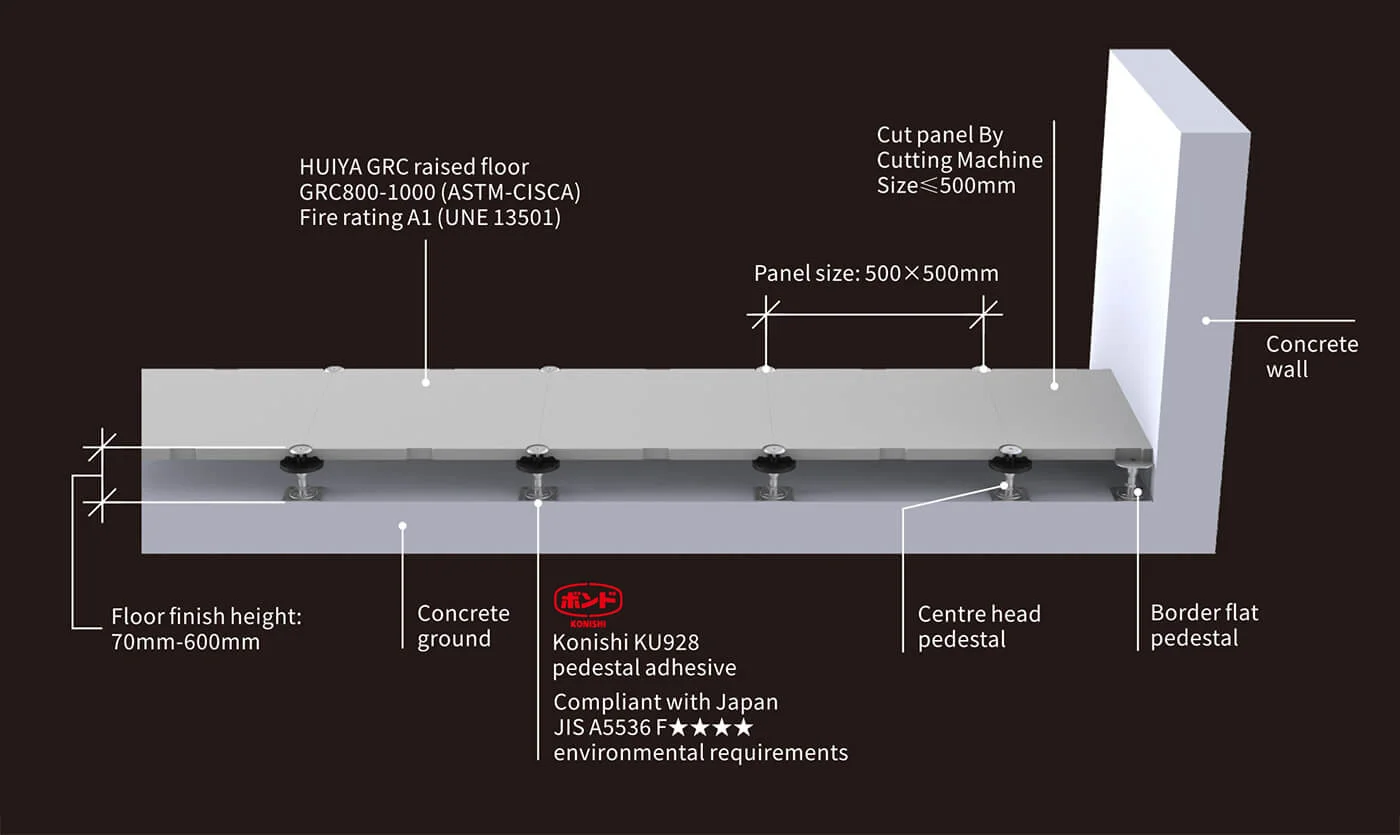
The key to the GRC panel’s cost advantage lies in its material composition. Rather than using a pressed calcium sulphate core or a stamped steel sandwich, the panel is built around a cement fiber matrix reinforced with a welded steel mesh. The cement provides compressive strength — typically 25 to 30 MPa after full cure — while the steel mesh handles tensile loads and prevents cracking during handling and installation.
This construction method is inherently less expensive than the alternatives. Cement fiber costs roughly one-third the price of calcium sulphate per unit volume. The steel mesh adds structural performance without the tooling and forming costs associated with deep-drawn steel sheets. For a manufacturer with established cement processing capability, the GRC panel represents the most efficient use of materials per unit of structural output in the entire raised floor product range.
The result is a panel that delivers a concentrated load rating of 5 to 8 kN — sufficient for typical office layouts, classroom configurations, retail floor areas, and light commercial corridors — at a per-meter cost that is 25 to 35 percent below the entry-level steel cementitious panel and 40 percent below bare calcium sulphate. For projects where the loads never exceed 5 kN per pedestal, paying more for a higher-rated panel is money spent on unused capacity.
Where GRC Excels: Three Proven Scenarios
Scenario 1: Education Facilities
Schools and universities install raised floors primarily for cable management — power, data, and AV cabling distributed beneath the teaching floor to keep classrooms and lecture theatres clean and adaptable. Load requirements are modest. A classroom with forty student desks, teacher workstations, and projection equipment rarely exceeds a concentrated load of 3 kN at any single point. The Cement Raised Access Floor GRC panel handles this with a comfortable margin while keeping the project budget intact.
University IT departments in particular have adopted GRC for computer labs and open-access learning spaces. The underfloor cable tray system eliminates trip hazards, allows rapid reconfiguration when lab layouts change each semester, and provides a professional appearance that students and faculty appreciate. The cost saving versus a steel cementitious spec can exceed USD 12 per square meter on a 2,000 m² installation — real money in a public-sector procurement context.
Scenario 2: Retail and Showroom Environments
Retail spaces evolve constantly. Floor layouts shift with seasonal collections, changing product categories, and rotating promotional displays. A GRC Raised Floor system under a carpet tile or luxury vinyl finish gives the store operations team the ability to reconfigure power and data points in hours rather than days, without core drilling or surface conduits.
For automotive showrooms, electronics retailers, and furniture galleries where the floor visual is critical and the load demands are moderate, GRC offers the lowest first cost of any panel that still qualifies as a structural raised floor under EN 12825. The cement fiber core also provides better acoustic damping than hollow steel panels, reducing footfall noise in sales areas where customer experience matters.
Scenario 3: Small to Medium Office Projects
For independent offices, co-working spaces, and professional service firms occupying one to three floors, the decision to install a raised floor often comes down to a single question: can we justify the premium over a standard concrete slab with cable trays? When the answer depends on budget, Cement Fiber With Steel Mesh Raised Access Floor panels make the math work. The installed cost — including pedestals, panels, and edge trim — frequently lands below USD 45 per square meter in competitive markets, compared to USD 60 or more for entry-level steel panels.
Smaller projects also benefit from the GRC panel’s lighter weight. At 12 to 14 kg per 600 × 600 mm panel, a single installer can handle placement without mechanical assistance, reducing labor costs and installation time on projects where the team size is limited.
Where GRC Is Not the Right Choice
Honest product education requires boundaries. GRC panels are not suitable for data centers, heavy industrial floors, or any environment where concentrated loads exceed 8 kN or where humidity is uncontrolled over long periods. The cement fiber core is less moisture-resistant than steel cementitious or encapsulated calcium sulphate, and it lacks the very high load ratings that AI data center racks and heavy manufacturing equipment demand.
But for the millions of square meters of educational, retail, and small office space being built and renovated worldwide every year, GRC represents the most rational intersection of cost and performance. It is not the panel for every project. It is the panel that makes raised floor technology a viable option for projects where it was previously priced out. That is its purpose, and it fulfills it admirably.
Download HUIYA GRC Technical Specification PDF