

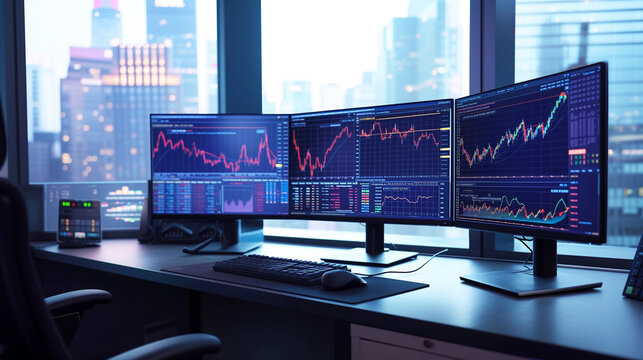
S&P futures are a key part of global finance, providing speculators with an opportunity to bet on or hedge against the direction of the combined U.S. stock market. The contracts are tied to the S&P 500 index—a standard consisting of 500 of the largest American companies—and are regarded as one of the most liquid and widely followed futures contracts globally.
For anyone interested in trading the S&P futures market, it's important to understand how these instruments work and how to select a sound futures trading platform. It's the difference between seamless execution and expensive mistakes. This article provides the fundamentals of S&P futures and the key elements to consider when selecting a trading platform for futures markets.
What Are S&P Futures?
S&P futures are standardized contracts to purchase or sell the S&P 500 index value at a future time. They trade on regulated futures exchanges and are widely used by institutional investors, hedge funds, and individual speculators.
Common Types of S&P Futures Contracts:
- Standard contracts – based on the full S&P 500 index
- E-mini contracts – 1/5 the size of the standard contract
- Micro contracts – 1/10 the size of the E-mini contract
These smaller-sized contracts have opened the futures markets to individual traders and smaller accounts. Regardless of the size, the objective remains the same: speculate on the future direction of the S&P 500.
Why Trade S&P Futures?
Trading S&P futures offers several advantages for both active traders and long-term investors:
1. Liquidity
S&P futures are among the most liquid contracts globally.
Benefits:
- Tight bid-ask spreads
- Faster order execution
- Reduced slippage
2. 24-Hour Market Access
Unlike traditional stocks, S&P futures are traded nearly 24 hours a day, five days a week.
This allows:
- Immediate reaction to global news
- Trading flexibility across time zones
3. Leverage
Futures contracts offer high leverage, allowing control of large positions with relatively low capital.
Caution:
Leverage can amplify both profits and losses, making risk management essential.
4. Hedging Capabilities
S&P futures are often used to hedge equity portfolios.
A short position in futures can offset losses in a long stock portfolio, making it a powerful tool for risk control.
Key Features of a Futures Trading Platform
The effectiveness of your S&P futures trading also depends on the capabilities of your trading platform. A solid platform should offer speed, analysis, reliability, and flexible risk management.
1. Order Execution Speed
Milliseconds can impact trade outcomes in futures markets.
Your platform should support:
- Lightning-fast execution
- Low latency for scalping and intraday trading
2. Market Depth and Order Flow
Platforms offering Level 2 market data provide full market depth, showing:
- Real-time order book
- Institutional activity
- Potential support and resistance zones
3. Advanced Charting Tools
Essential for technical analysis, charting tools should include:
- Multiple chart types (candlestick, line, bar)
- Custom indicators and overlays
- Drawing tools for trendlines and patterns
- Timeframe flexibility (from 1-minute to daily/weekly)
- Price alerts and automation features
4. Variety of Order Types
A reliable platform should support:
- Market orders
- Limit orders
- Stop-loss orders
- Trailing stops
- Bracket orders (automatically set both stop-loss and take-profit)
These order types help with risk control and trade planning.
5. Built-In Risk Management Tools
Risk management is critical in leveraged markets. The platform should offer:
- Real-time account and margin monitoring
- Drawdown tracking
- Customizable risk per trade
- Margin call alerts
6. Desktop and Mobile Synchronization
Modern traders need flexibility across devices. A good platform should provide:
- Seamless switching between desktop and mobile
- Consistent user interface and functionality
- Real-time updates and trade notifications
Trading Strategies with S&P Futures
Once equipped with the right tools and understanding, traders can apply several effective strategies when trading S&P futures:
1. Trend Following
- Identify long-term trends using moving averages or momentum indicators
- Enter trades in the direction of the trend
- Use ATR, recent highs/lows to define stop-loss and targets
2. Mean Reversion
- Wait for price to deviate significantly from the mean (e.g., Bollinger Bands)
- Enter trades expecting a return to the average
- Typically higher win rate, but smaller reward-to-risk ratios
3. Breakout Trading
- Spot price consolidations or tight ranges
- Anticipate a breakout above resistance or below support
- Confirm breakouts using volume or volatility indicators
4. Scalping
- Execute multiple small trades per session
- Profit from minor price movements
- Requires:
- Ultra-fast execution
- Low commissions
- Minimal slippage
- Tight spreads
- Ultra-fast execution
Final Thoughts
S&P futures are an ideal financial instrument for traders and investors seeking exposure to the U.S. equity market. They offer unmatched liquidity, extended trading hours, and significant leverage. These factors make them highly appealing to active and strategic participants.
However, success in trading S&P futures depends not just on strategy and discipline, but also on the trading platform used. The platform should be built for futures trading—offering robust data access, fast execution, customizable risk controls, and a suite of analytical tools.
With the right combination of market insight, strategy, and technology, trading S&P futures can open the door to opportunity across varying market conditions.